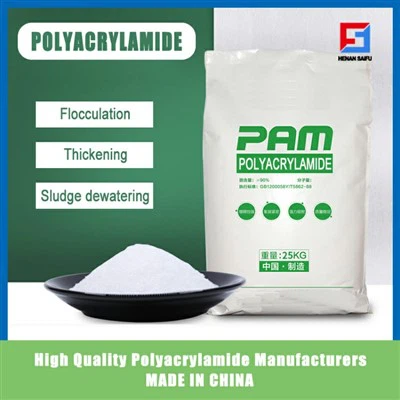
How can one quickly and accurately select the appropriate flocculant? Before treating wastewater, it is essential to consider the type of wastewater to ensure a more accurate and rapid selection process. So, what factors should be considered when choosing a flocculant?
Sludge is a byproduct of wastewater treatment. It is important to understand the sludge's source, properties, composition, and solids content. Based on the primary components, sludge can be classified as either organic or inorganic. Generally, cationic flocculants are used for organic sludge, while anionic flocculants are used for inorganic sludge.

Cationic flocculants are generally unsuitable for use under strongly alkaline conditions, whereas anionic flocculants are unsuitable for strongly acidic conditions. Higher solids content in the sludge typically requires a larger dosage of flocculant.
Selecting Flocculant Ionicity: For sludge requiring dewatering, small-scale experiments can be conducted to screen flocculants with varying degrees of ionicity. This helps identify the ideal product to achieve optimal flocculation results while minimizing dosage and reducing costs.
Key factors in selecting ionicity include: floc size, floc strength, and moisture content.
Flocculant Particle Size: If particles are too small, drainage speed is unaffected; if too large, they may fail to bind sufficient water or effectively reduce sludge volume. Particle size can be adjusted by selecting a flocculant with the appropriate molecular weight.
Flocculation Strength: Flocs must remain stable and not break apart under shear forces. Increasing the flocculant's molecular weight or selecting an appropriate molecular structure helps enhance stability.
Mixing Flocculant with Sludge: The flocculant must react fully with the sludge at a specific point within the dewatering equipment to induce flocculation. Therefore, the flocculant solution must have an appropriate viscosity to ensure thorough mixing with the sludge given the existing equipment. Uniform mixing is a critical factor for success. The solution's viscosity depends on its molecular weight and concentration.
Flocculant Dissolution: A flocculant can only perform effectively if it is fully dissolved. Sometimes, it is necessary to accelerate the dissolution rate; in such cases, increasing the solution concentration may be considered.