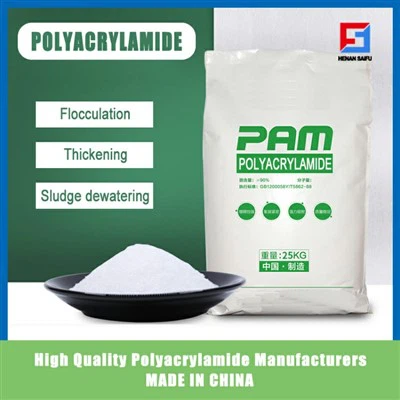
Scope of Application for Anionic Flocculants:
1. Anionic flocculants are widely utilized in the textile and printing and dyeing industries. They serve as fabric sizing agents and finishing agents, capable of forming a protective layer that is flexible, wrinkle-resistant, and mildew-proof. Due to their strong hygroscopicity, they help reduce the breakage rate during the spinning process. Polyacrylamide, specifically, can be employed as a finishing agent to prevent static electricity accumulation on fabrics and to enhance their flame retardancy. When used as a printing and dyeing auxiliary, these flocculants impart excellent color fastness and high whiteness to the finished products; they also function as non-silicone polymer stabilizers for bleaching processes.
2. Primarily used as flocculants: These agents are particularly suitable for treating wastewater characterized by a high concentration of suspended particulate matter-specifically particles carrying a positive charge-within water bodies exhibiting a neutral or alkaline pH. This efficacy stems from the presence of a certain quantity of polar basic groups within the molecular chains of anionic flocculants; these groups enable the adsorption of suspended solid particles in the water, creating "bridges" between the particles. Consequently, this accelerates the sedimentation of particles within the suspension, hastens the clarification of the liquid phase, and facilitates filtration processes. This product is extensively applied in water treatment operations across a diverse range of industries, including chemical wastewater treatment, industrial liquid waste disposal, municipal sewage treatment, general water purification, high-turbidity water clarification, sedimentation processes, coal washing, mineral processing, metallurgy, steel manufacturing, zinc and aluminum processing, and the electronics industry.
3. Applications in the petroleum industry: Anionic flocculants are widely utilized in drilling fluids and waste drilling mud treatment. They help prevent fluid channeling, reduce frictional resistance, and significantly enhance oil recovery rates-potentially boosting recovery yields by up to three times.
4. Applications in the papermaking industry: Firstly, they serve to increase the retention rate of fillers, pigments, and other additives, thereby minimizing raw material loss and reducing environmental pollution. Secondly, they enhance paper strength (encompassing both dry and wet strength). Furthermore, the use of anionic polyacrylamide improves the paper's tear resistance and porosity, while also enhancing its visual appearance and printability; it is also suitable for use in the production of packaging paper for food and tea products.
5. Applications in other industries: These flocculants can be utilized for the clarification of sugarcane juice, as well as for the phosphate flotation extraction of syrups during the production of sugarcane sugar and beet sugar. It can also be utilized for the recovery of feed proteins-yielding a product of stable quality and excellent performance-where the recovered protein powder serves as an ingredient in chicken feed, thereby enhancing survival rates and weight gain without adversely affecting egg production. Furthermore, it finds application in synthetic resin coatings; civil engineering grouting materials for water sealing; the building materials industry (specifically for improving cement quality); construction adhesives; joint fillers and repair agents; soil conditioning; the electroplating industry; the textile printing and dyeing industry; and various other sectors.